
Dear Friends,
Thank you. For the gift. The card. The conversation. Facilitating EI Surf Club has been one of the real joys in my life. Ten weeks with yoga and ten weeks with barrier island ecology. I already have plans for the next ten weeks of learning later this summer and fall.
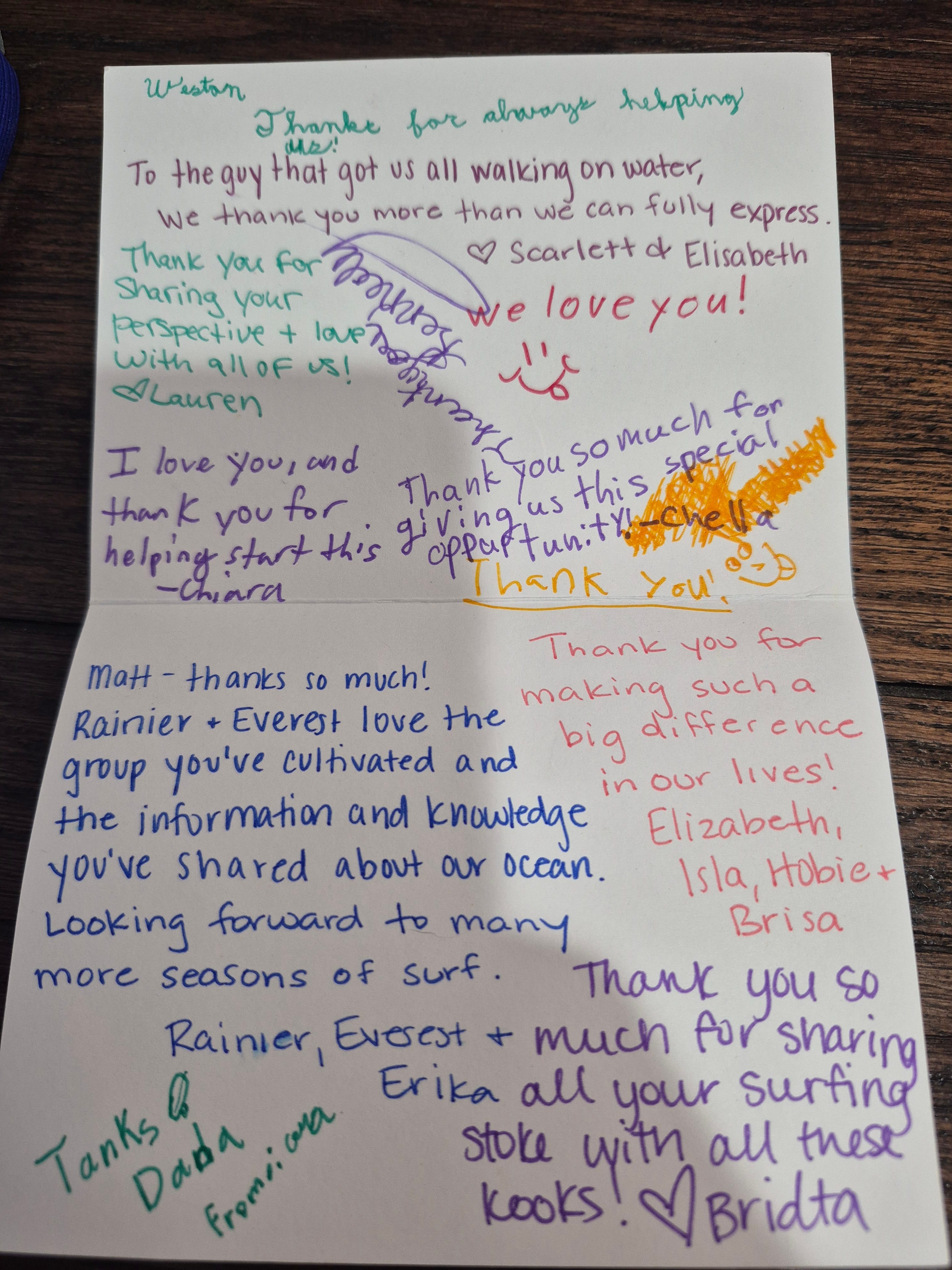
No better way to celebrate Father’s Day than to recall those moments, you friends, and to vision that future we are creating together. I’ve been learning a lot, and I hope everyone is. Waves and waffles, all those kids in the kitchen. Relationships born, growing, maturing. The best.
I started saying all of this in a text, but that was like a thousand words, so… a letter instead.
I’ve got a bunch of points I want to make here, so bear with me if you’re able.
The question we started with
We, our family, started our homeschooling with a question: “What kind of education do these kids need to create a future we want?”
Ant and I had known we wanted to opt out of conventional education for a while. I was certain the education system was built for a world that is fraying fast — a world that perhaps no longer exists. It was designed to sustain the world we had built. It was not fit to create futures we want. It was not designed to create futures for the well-being of all. It was built to teach narrow knowledge subjects. To ignore and actively remove the “invisibles” (what matters but resists measurement) and anything “irrelevant” to economic growth and dominance. The education of modernity was not designed to nourish and nurture children and societies. It would not allow us to flourish and thrive. It would not honor our most precious values.
So, back to the question: What kind of education generates flourishing and thriving? Nurtures and nourishes? Honors our most precious values? Is fit for creating futures we want?
A response? An education that holds up and prioritizes:
Wisdom
Values
Learning to learn
Adaptation
Vision
Partnership
Nature
Humanity
Creativity
Compassion
An inevitably partial list. But that is a start to a conversation I’d like to have more often.
What I believe
The education system, and the world that built it, are fraying, degrading. We, all of us, are entering a new phase in our lives, societies, and evolution.
We must be more disciplined and systematic, creative and risk-taking, in our education of what is most important and most urgent for our children and all of us. Entrepreneurship may be the only job in the not-too-distant future. We should embed that likely outcome in our education.
We must put the ruler down. Stop measuring our learning and progress against increasingly irrelevant paradigms of how our lives and the world work.
The clock is ticking. We have a moment to adapt, to partner, to adjust, to learn, to rapidly evolve, to vision and create futures we want rather than unconsciously drift with the world that others have built. Others whose values are not ours. To wait may mean the opportunity is gone forever.
I believe we are courageous. Each of us. We chose. We choose. We opted out. Against the current. We have exercised our right to honor our agency. Autonomy. To create. To learn. To vision. We are not beholden to what the school may tell and do. And so we may be reflexive. We may courageously show our children the traits, the principles, the values, the beliefs they will need to craft the paths toward their identity. The person they are to be. For themselves, and for all of us.
My fear — perhaps my greatest — is that I have these beliefs, the knowledge, the experience, the vision, but am too cowardly to do what is needed. This is what keeps me up. And does not let me rest.
So what do we do? We select and make the soil. We nourish it. We turn all of our energy, all of ourselves, into our Love. We exhaust ourselves. And so we watch and breathe and feel with the weather and the sea and the world. We stand in the waves and we reflect and we learn. And, always, we return to our gardens, and tend what grows. And our wisdom matures. And we go on.
This is a learning ecology. Each of us has chosen it and contributed to it in our own ways.
But HOW do we do all of this? And WHAT exactly does it look like? This is where I want to be more purposeful. More intentional. More systematic. More wise.
What “subjects” comprise our Learning Ecology?
The following are core to our home’s Learning Ecology. Most are rarely in a child’s education, or anyone’s. And yet, for creating futures we want, I increasingly prioritize them over almost every subject I was ever exposed to. A quick word on each, since the names alone can be opaque:
Evaluation Science — the discipline of judging what is valuable and whether what we’re doing is actually working — critical thinking made rigorous by our values.
Design — shaping our tools, spaces, and experiences on purpose, instead of accepting whatever we inherit.
Systems Thinking — seeing the whole — the relationships, patterns, and feedback loops — rather than isolated parts.
Complexity Sciences — how order, change, and surprise emerge in living systems that can’t be fully predicted or controlled.
Human Systems Dynamics & Adaptive Action — a practical way to see and shift the patterns inside any group of people, using one simple cycle — What? So what? Now what?
Wisdom and Philosophy — the oldest human questions — how to live, what is true, what is good — and the practice of thinking clearly about them.
Values — not just holding values but understanding them: where they come from, how they form, and how we tend them. (I call this values theory.)
Vision — imagining the futures we want vividly enough to move toward them.
Creativity — making new things, and finding the courage to bring them into being.
Deep Praxis — learning by doing and reflecting, around and around — we act so that we may know, and know so that we may act.
Ecology — how living things relate to one another and their surroundings — and a mirror for understanding ourselves.
Nature — a direct, unhurried relationship with the living world we are of and part of.
How do we learn these things?
Not in a classroom. No, no. For many years and in many ways, I’ve taught most of these subjects to adults (hundreds, perhaps thousands) and more recently to Chiara and Cora. It is always true that the richest environments for learning these things are rarely classrooms or desks, but instead living, relational spaces:
In service to community
In conversation
With a garden
With Surf
On a hike
Preparing a meal
Hosting a party
With friends and families
With questions
Watching a film
Playing games
Listening to music
Creating artworks
Entrepreneurship
Discovering and examining assumptions and worldviews
Paddling through salt marshes
Travel
Time together
This is already something of our family’s, and your family’s, Learning Ecology today. But I believe we can be more purposeful. I believe we must. Any and all of it is more relevant, more powerful, as a community. More explicitly in partnership, learning partnership.
A grand vision: the Wisdom Studio
My grand vision is a Wisdom Studio. A large home on the beach, down near the point, for us, together, to do the work required for futures we want. Let’s call that vision “a work in progress.”
And sooner — a Wisdom Camp
In the meantime, I have another vision. A Wisdom Camp. I’ve been designing it for Chiara and Cora. Perhaps it is just for our family. Maybe this is not of interest to others. But it feels right to share it with this group and see where the conversation goes.
Since 2018, when I began designing our education and, more recently, the Wisdom Studio, I’ve gathered a large collection of tools, methods, constructs, perspectives, philosophies, and projects of all sorts. A Wisdom Camp would draw from these, each one chosen to increase our capability to create futures we want.
What might it look like? Doing all of what I just described:
Learning visioning and futuring in the garden
Designing a deep praxis in Surf
Complexity sciences through barrier island ecology
Systems thinking through Games
Wisdom and philosophy through conversation
Design through hosting a party
Values through service to community
Evaluation through preparing meals and tending a garden
And the shape of the week? A week at our home. Monday to Friday. All together. Overnight. Just kids? A few parents? A few families? This could be September. Maybe August. The summer seems booked up. But sooner than later.
This letter is something I’ve been composing in my head for a while. Your card prompted it to be written today, on Father’s Day. There is no better way to use my energy on this day than to put it into this wonderful opportunity: to be a father, and a partner, and a part of this community. Thank you.
I hope this sparks some conversation. I would, of course, host conversations about any and all of these topics anytime, if there is interest.
With gratitude,
Matt
P.S. If you’d like to know more about the thinking behind all this, the whole Substack is mine — a few hundred essays. Here are a few series and individual essays that might be a good place to start:
I didnt know this was a required class in France. Or anywhere in public school.
And still, why wait until 17 for our education to purposefully and systematically grapple with these most essential and human subjects/values?
https://www.nytimes.com/2026/06/19/world/europe/france-education-high-school-philosophy.html